KK Women's and Children's Hospital will NEVER ask you to transfer money over a call. If in doubt, call the 24/7 ScamShield helpline at 1799, or visit the ScamShield website at www.scamshield.gov.sg.
This story was reproduced from the Singapore Health Special Edition on Nursing 2016
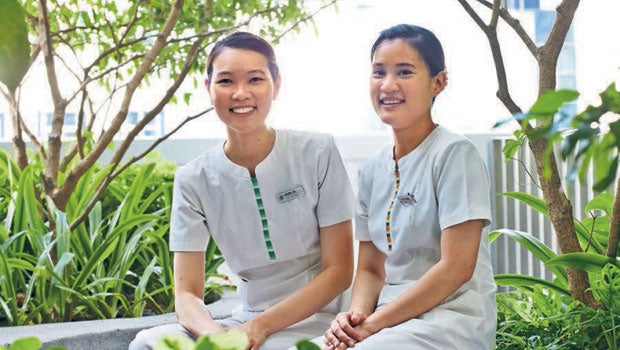
At the mobile clinics, Ms Ho (left) and Ms Hong (right) perform health screenings and give medical advice to the villagers
Project Light
Travelling to remote villages in the mountains of northern Thailand to provide medical care is no walk in the park. But knowing how welcome their presence would be to the villagers was more than enough for Singapore General Hospital (SGH ) Senior Staff Nurse Felicia Ho to keep making that arduous trip to reach out to these communities with little or no access to regular health care.
In January, Ms Ho co-led a team of seven nurses and two doctors on a medical mission to the country, the second such trip she has undertaken for Project Light, which was started by some alumni nurses from the Alice Lee Centre for Nursing Studies, Yong Loo Lin School of Medicine, National University of Singapore.
“In addition to the pre-trip preparation, which involved seeking funding and support, it was also a challenge to coordinate our leave schedules as we all work at different institutions,” said Ms Ho.
“But the tough preparation was worth it. It was a great opportunity for us to be able to make a difference in the lives of those in the Hmong community.” Ms Ho also worked with Radion International, a Singapore relief and development organisation based in Thailand, to plan the trip.
The team saw patients at a mobile clinic, but also ventured often to homes when the elderly or infirm were not able to make the journey to their clinic. They also distributed warm clothes and food to the villagers.
Operating in such a remote area meant that resources were limited and the team often had to make do with what was available. Said Senior Staff Nurse Hong Yan Qi, Department of Ambulatory Treatment Unit, National Cancer Centre Singapore (NCCS): “Even though we were mentally prepared to have limited resources, we were still surprised by what was actually available to us. When setting up our mobile clinic, for example, school desks were used to create a makeshift examination table and old bed sheets served as curtains for some privacy.”
The nurses hope to make more trips. “We plan to increase our visits to twice a year so that we can provide more consistent care for the communities there,” said Ms Hong.
Nurse Clinician Junaidah Nawi (left) and Nurse Manager Lim Lee Ngoh, both from KKH, have been on a total of 10 medical mission trips. Photo: Alvinn Lim
Left: Ms Junaidah (in blue) helping a patient in Cambodia. Right: Ms Lim (fourth from left, in blue vest) and her team in Sukkur, Pakistan.
Medical missions
Many nurses go the extra mile in their jobs. But two veteran nurses of KK Women’s and Children’s Hospital (KKH), Nurse Manager Lim Lee Ngoh and Nurse Clinician Junaidah Nawi, have literally travelled thousands of miles to offer much-needed medical care to people in disaster-hit areas.
On many of their 10 medical missions to seven disaster-hit countries, they worked with local hospitals to set up training programmes and standard protocols in areas like the management of obstetric emergencies.
Going to Pakistan in 2010 was particularly memorable for Ms Lim. “I was part of the SingHealth medical aid team formed in collaboration with Mercy Relief to help flood victims there,” she said.
“We were based in Sukkur, on the west bank of the Indus River. We set up a clinic from scratch. Similar to a hospital’s A&E, we had a registration counter, triage area, areas for consultations, procedures and dressings, as well as a pharmacy.”
“Basic” took on a new meaning on that trip. “Armed with the bare necessities, we had to improvise and work with what we had. For instance, we used cardboard pieces as splints to secure intravenous cannula for infants prior to transportation to the local hospital,” said Ms Lim. “Used sharps and needles were discarded into empty mineral water bottles to prevent injury.” In hospitals, used sharp instruments that can cause injury and contamination are thrown into biohazard sharps containers.
Ms Lim added that one of the “perks” of going on mission trips is the strong camaraderie formed with fellow nurses. She said: “While we have designated roles, everyone is always looking out for one another and ready to offer help when the need arises.”
It was also back to basics when Ms Junaidah went on teaching trips to countries like Laos, Cambodia and India, where she helped hospitals set up standard protocols to deal with maternal post-partum haemorrhage and neonatal emergencies.
“I taught my foreign counterparts to have two emergency kits, complete with all the required instruments and premeasured drugs, in their delivery rooms,” Ms Junaidah said.
“These are mandatory in managing high-risk obstetric conditions such as post-partum haemorrhage (post-delivery bleeding) and severe pre-eclampsia. These kits help to save time in an emergency and increase the chances of survival for the mother. This is what we practise in KKH too.”
When training nurses, she looks out for potential master trainers, giving them extra coaching to enable them to pass on skills and knowledge to other nurses.
Ms Junaidah feels privileged to be part of these mission trips. She said: “In sharing my knowledge with others, I also learn and benefit from the interaction.”
Click Here to read more inspiring stories about nurses from the Singapore Health Special Edition on Nursing 2016

.jpg)
.jpg)
.jpg)















 HealthXchange
 Health Videos


